Librarianship | Page 13
Blended Learning Concordia University Information literacy
Thoughts on a university library’s role in blended learning
Olivier Charbonneau 2012-04-26
We had a very interesting meeting today with Concordia’s Center for Teaching & Learning. The goal of the presentation was to explore partnership ideas, but we also discussed how the Library could contribute to a blended learning initiative at our institution.
Here are some thoughts about the blended learning environment (I purposefully use the environment paradigm, which I borrow from systems theory as posited by Luhmann)
Firstly, the main point brought was the idea of a “learning object” – a concept that we did not quite hammer out. I would offer this personal definition : a learning object is a type of document that presents information or knowledge to enable a learner to achieve a specific outcome. A learning object may (recursively) contain one or many other learning objects. Templates are useful tools to present this information or knowledge in a structured way. A learning object repository is a collection of curated learning objects, with associated metadata.
Secound, I would like to point out that there are many agents in this environment : the learners (obviously), the instructor or their assistant, the content owners and the system administrators. Each one of them has a role to play in the conception, organisation and provision of learning objects to learners.
Of course, the goal would be to identify all the learning objects and all the agents that are relevant in this environment. It may be easier to start with all the distinct templates of learning objects (as there may be too many learning objects).
Which now brings me to this conceptual model:
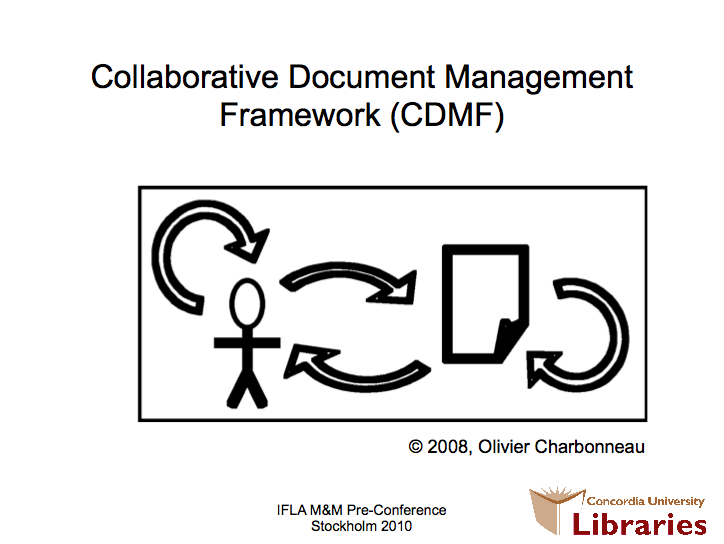
I devised this model during the course of my graduate degree in law (I’ve explained it on this blog post) and I’ve presented it at an IFLA Pre-Conference.
Now, this model tries to map out the Web 2.0 environment – I will make the claim that “blended learning” is functionally equivalent to Web 2.0 on a conceptual level (sorry for not prouving this point thoroughly – more on that later perhaps).
It is defined as 2 elements, documents and agents, interacting through 4 generic relationships: linking (document-document); conversations or intermediations (agent-agent); using (document-agent); and contributing (agent-document). This is meaningful in a discussion of a library’s role in a blended learning environment as is helps define exactly where it may be useful.
Specifically, I find that the priority is to identify areas where librarians may be contributing content – creating learning objects, followed closely to linking these learning objects to form paths through the knowledge base. Finally, librarians may play a role in the conversations that may happen in the environment between the various agents (focussing, as a priority, with the conversations that happen with the gatekeepers of knowledge: instructors and their assistants).
Of course, this is an off the cuff exploration of a complex topic, where I pin some broad concepts on a simplification of the real world. But it makes sense ! Please feel free to share comments or questions below…
Special thanks to Pamela Carson and Vince Graziano, two colleagues from Concordia University Libraries, for our very interesting conversation that was instrumental in organizing this post.
Librarianship
Measuring academic tweets
Olivier Charbonneau 2012-04-17
A recent post on the Inside Higher Ed blog points to a study about measuring the value of “microblog content” or tweets. Ernesto Priego states:
Using a corpus of approximately 43,000 ratings, the authors asked: “What content do Twitter users value? For example, do users value personal updates while disliking opinions?” and “Why are some tweets valued more than others?”
The study is self-archived on the author’s website. Here is the full reference:
Paul André, Michael S. Bernstein and Kurt Luther
“Who Gives A Tweet? Evaluating Microblog Content Value”
Author copy of final version.
CSCW’12, February 11–15, 2012, Seattle, Washington
2012 ACM Conference on Computer Supported Cooperative Work.
Librarianship Read Me
Thinking of the future
Olivier Charbonneau 2012-04-16
Here are a few reports that people around me have praised or hated, listed in no particular order, just to keep track of should I have a sleepless night:
Think Like A Startup: a white paper to inspire library entrepreneurialism by Brian Mathews
Redefining the Academic Library : Managing the Migration to Digital Information Services by the University Leadership Council (on which Jeff Trzeciak participated)
Ithaka S+R Library Survey 2010: Insights From U.S. Academic Library Directors
Peter Hernon, “Becoming a university library director“, Library and Information Science Research, 33-4 (October 2011), pg. 276-283.
Guidelines - recommendations Information literacy
ACRL Guidelines for instruction programs
Olivier Charbonneau 2012-04-13
This just in, the updated Association for College & Research Libraries ACRL Guidelines for instruction programs in academic libraries, published in the most recent issue of C&RL news.
Guidelines - recommendations Information literacy
IFLA launches information literacy recommendations
Olivier Charbonneau 2012-04-12
The Information Literacy Section of the International Federation of Library Associations & Institutions (IFLA) announces new Media and Information Literacy Recommendations, developed with UNESCO’s Information for All Programme (IFAP).
Guidelines - recommendations
French Business School Librarians
Olivier Charbonneau 2011-11-29
Just stumbled on this: ACIEGE (http://www.aciege.org/): Association des responsables des Centres d’Information des Ecoles de GEstion – or the association of business schools heads of libraries.
Information literacy Read Me Reference
New CAIJ issue: innovation, uncertainty and perceptions
Olivier Charbonneau 2011-11-15
The Canadian Association of Information Science has delivered its latest issue of its Canadian Journal of Information and Library Science (via Project Muse on behalf of UT Press, the publisher), vol. 35 issue 4.
A few articles seem particularly interesting, such as:
Enhancing Skills, Effecting Change: Evaluating an Intervention for Students with Below-Proficient Information Literacy Skills / Renforcer les compétences pour induire des changements : évaluation d’une intervention auprès d’étudiants possédant des compétences informationnelles inférieures à la maîtrise
Don Latham
Melissa Gross
pp. 157-173
and
Subject Guides in Academic Libraries: A User-Centred Study of Uses and Perceptions/Les guides par sujets dans les bibliothèques académiques : une étude des utilisations et des perceptions centrée sur l’utilisateur
Dana Ouellette
pp. 226-241
Of course, all articles seem interesting, but there is so little time to read everything!
Librarianship Reference
Reference as listening: 5 exercices to listen better
Olivier Charbonneau 2011-10-20
Julian Treasure presented 5 ways to listen better at TED – the always entertaining and smart talks about ways to change the world. I thought it added some insight about how to provide for a better reference service :
[ted id=1200]
Information literacy Inspiration
Some MERLOT with PRIMO for inspiration
Olivier Charbonneau 2011-10-19
This post presents the PRIMO (Peer-Reviewed Instructional Materials Online) and the MERLOT (Multimedia Educational Resource for Teaching and Learning) projects.
PRIMO
Under the ALA/ACRL umbrella, one can find the PRIMO Committee of the Instruction section. Of the many things they do, they offer a database of Peer-Reviewed Instructional Materials Online – aka the PRIMO database.

I remember in the past that a team at Concordia University Libraries (of which I was a member) was awarded the “site of the month” award for June 2006 from the PRIMO Committee for our InfoResearch 101 project.
MERLOT
I remember stumbling on the MERLOT (Multimedia Educational Resource for Teaching and Learning) repository about a year ago. It contained a few interesting sites relating to business, such as Stanford’s Educators Corner or the Beginner’s Guide to Business Research.
According to their site, MERLOT is a
MERLOT is a free and open online community of resources designed primarily for faculty, staff and students of higher education from around the world to share their learning materials and pedagogy. MERLOT is a leading edge, user-centered, collection of peer reviewed higher education, online learning materials, catalogued by registered members and a set of faculty development support services.
Assessment Concordia University Guidelines - recommendations
AACSB Accreditation Standards
Olivier Charbonneau 2011-10-19
I am very lucky to be a business librarian at Concordia University – this is true on so many levels! Of all the reasons, the fact that the John Molson School of Business is accredited by the Association to Advance Collegiate Schools of Business (AACSB) may be a boon to work towards integrating information literacy in the curriculum.
As their website shows, the AACSB has Accreditation Standards to which JMSB must adhere to. These include the concept of total quality management – or making the most of the resources you have. It also assists in comparing business school together. Every so often, accredited schools must undergo a review process (audit), which serves as a nice entry point should you want to propose changes to how things are done – an external review fosters the feeling of continuous improvement.
For example, the “Assurance of Learning Standards” offers a few points where a library could have a positive impact… these are straightforward issues that school educators must report back on – so they are easily actionnable!