Guidelines – recommendations
Academic Integrity Guidelines - recommendations Information literacy
Action items for teaching in the age of GenAI
Olivier Charbonneau 2026-06-02
The goal of this workshop is to enable teaching faculty to perform a self-assessment of GenAI readiness in order to articulate a personal action plan.
Objectives
- Articulate a personal reflexion about the use of GenAI in one’s praxis
- Determine a strategy to upskill around GenAI
- Identify 3 simple action items
GenAI today
Rutgers University offers an Artificial Intelligence in Accounting and Assurance Concentration.
AACSB runs a yearly survey of Deans and Faculty use of Gen AI: the general consensus surmises that the best approach to integration implies the upskilling of faculty so that they may become key stakeholders in leading the change. EDUCAUSE Review 2026 leans heavily in this same direction.
In terms of complexity: Machine learning < Deep learning < … < generative artificial intelligence. A “grading bot” is likely to be some kind of classifier algorithme, closer to deep learning than a full LLM enables GenAI tool.
Sam Altman, CEO of OpenAI on what ChatGPT, during the Town Hall held on January 26th 2026, on what ChatGPT fails to do well: creativity; intuition; judgment (at 27th minute of video). Mindset for humans using GenAI: abundance; resilience; collaboration (ibid).
Tour de table
Please answer the following questions:
- What is your name?
- How would you self describe your own knowledge and comfort using Gen AI?
- What scares you the most about Gen AI?
- What excites the most?
- What is your next step?
Action items brainstorm
Many resources are offered at Concordia and beyond. The Center of Teaching and Learning offers Guidelines on teaching as well as assessment design. The Library provides a online learning module called GenAI Quickstart: Foundations for Faculty. Many “classes” are available on prompt engineering or GenAI via the university’s Udemy subscription.
Let’s ask Copilot for some ideas:
you are a senior librarian working in a large metropolitan canadian university. You need to lead a workshop on generative ai for the benefit of teaching faculty in the accountancy department. could you identify a list of 10 simple action items that faculty may explore tomorrow to upskill on gen ai use in their praxis and make for a future ready teaching strategy
Response
Absolutely—here’s a practical, low-barrier set of 10 action items accountancy faculty can try immediately to build confidence with generative AI and begin integrating it into teaching in a responsible, future-ready way.
10 “Start Tomorrow” Actions for Accountancy Faculty
1. Draft Better Lecture Outlines in Minutes
Paste a syllabus topic (e.g., revenue recognition, auditing standards) into a GenAI tool and ask:
“Create a 60-minute lecture outline for undergraduate accounting students, including examples and discussion questions.”
✅ Benefit: Saves prep time and introduces new ways to structure content.
2. Generate Realistic Practice Problems
Ask AI to:
“Create 5 intermediate-level problems on lease accounting with solutions.”
✅ Benefit: Quickly expands problem banks and supports differentiated learning.
3. Create Case-Based Learning Scenarios
Prompt:
“Generate a short case where a company faces ethical issues in financial reporting.”
✅ Benefit: Supports critical thinking and aligns with CPA competencies.
4. Simplify Complex Concepts for Students
Paste a dense accounting standard and ask:
“Explain this in plain language for first-year students.”
✅ Benefit: Improves accessibility and inclusive teaching.
5. Design In-Class Activities
Prompt:
“Create a 20-minute group activity on internal controls for a class of 40 students.”
✅ Benefit: Encourages active learning without extensive prep.
6. Build Rubrics Quickly
Ask:
“Create a grading rubric for a financial analysis assignment, including criteria and levels.”
✅ Benefit: Standardizes grading and saves time.
7. Generate Multiple Versions of Assignments
Prompt:
“Create 3 slightly different versions of this accounting problem for academic integrity.”
✅ Benefit: Helps reduce cheating while maintaining fairness.
8. Use AI as a “Student Simulator”
Ask:
“Act as a student and ask questions about cash flow statements.”
✅ Benefit: Reveals likely student misunderstandings in advance.
9. Provide Feedback on Student Writing (Drafts)
Paste anonymized student work and ask:
“Suggest constructive feedback on clarity and argumentation.”
✅ Benefit: Speeds up feedback cycles while maintaining quality.
⚠️ Reminder: Avoid uploading identifiable student data—follow institutional privacy policies.
10. Start a Classroom Transparency Practice
Introduce AI explicitly to students:
- Show how you use it to generate examples
- Discuss ethical use in accounting education
- Co-create guidelines for acceptable use
✅ Benefit: Builds digital literacy and academic integrity awareness.
Bonus: A Simple First Prompt to Try
If faculty only try one thing:
“I am teaching intermediate financial accounting. Generate a short, engaging classroom example explaining deferred tax liabilities, including numbers and a step-by-step explanation.”
Framing for Faculty
- Start small—augmentation, not replacement
- Focus on efficiency + pedagogy
- Emphasize critical evaluation of AI outputs
- Align with professional standards (e.g., CPA competencies, ethics)
If you’d like, I can also turn this into a 1-hour workshop plan, slides, or a hands-on exercise sheet tailored to your department.
Guidelines - recommendations Industries and Markets Publishing Universities
Introduction to copyright and generative artificial intelligence
Olivier Charbonneau 2026-03-24
In this post, I provide some introductory remarks on copyright and generative artificial intelligence (GenAI) for colleagues in the accountancy department at the John Molson School of Business (JMSB) at Concordia University.
1. How does copyright work?
Copyright is enacted by a federal statute, whereby conferring economic and artistic rights to creators of qualifying works. These rights may be mobilized by contracts or agreements, often called licenses when they are limited in scope. Copyright agreements mobilize copyrights with regards to many components, such as monetary flows, duration and termination, geographical dimension, markets, exclusivity, transferability… the complexity and nature of copyright agreements is up to the parties involved, the federal statute allows for an almost infinite combination of arrangements. When mobilizing exclusive rights, an agreement is necessary.
Copyright ownership is usually vested in the original creator. In Canada, employers are assigned the ownership of copyrighted works produced by their full time & permanent employees, unless their work contract stipulates otherwise. At Concordia, the CUFA collective agreement reverts copyright back to faculty with the University retaining a license on all materials for educational purposes for a decate. On the other hand, the CUPFA collective agreement, governing contractual workers, is silent in the matter.
In recent years, the digital environment has introduced a new kind of agreement, open licenses, which facilitate the sharing, reuse or distribution of online content without remuneration. These include Creative Commons or open source software licenses. At Concordia University Libraries, we support the transition to open access through open textbooks, open scholarship, and Spectrum, our open archive. Open licenses are essential to the movement toward open access.
In addition to economic and artistic rights, the Copyright Act edicts exceptions that are afforded to user communities in specific and limited circumstances. The most notable are the “fair dealings” exceptions, not to be confused with “fair use” in the USA. In Canada, there are eight fair dealings: education, research, private study, news reporting, parody, satire, criticism or review. In the “CCH Case” of 2004, the Supreme Court of Canada established boundaries to fair dealings. Other exceptions include those for the print disabled, for libraries and archives, or for educational institutions. When one qualifies for an exception, use may proceed with neither an agreement nor a payment. Libraries are often tasked with governing copyright exceptions.
Also, Copyright establishes institutions that govern the artistic, cultural, creative or communication ecosystems. These include collecting societies which automate or streamline rights clearance, a specialized tribunal, review parameters as well as other measures. In the educational sector, Copibec is a collecting society which offers licenses for reprography or digital use of textual material, most notably coursepacks. Similarly, the Library offers digital collections under licenses to the university community.
Finally, copyright interacts with many other legal regimes, most notably provisions in the Civil Code of Québec, which govern contracts or image rights, or federal telecommunications regulations, which govern what is broadcast on national airwaves.
For more information about Copyright, please access Concordia University Library’s Copyright Guide, the Policy on Copyright Compliance (SG-2), the Copyright Guidelines for instructors or simply ask your librarian before contacting anyone outside the organization about copyright.
1.1 Simplified copyright workflow
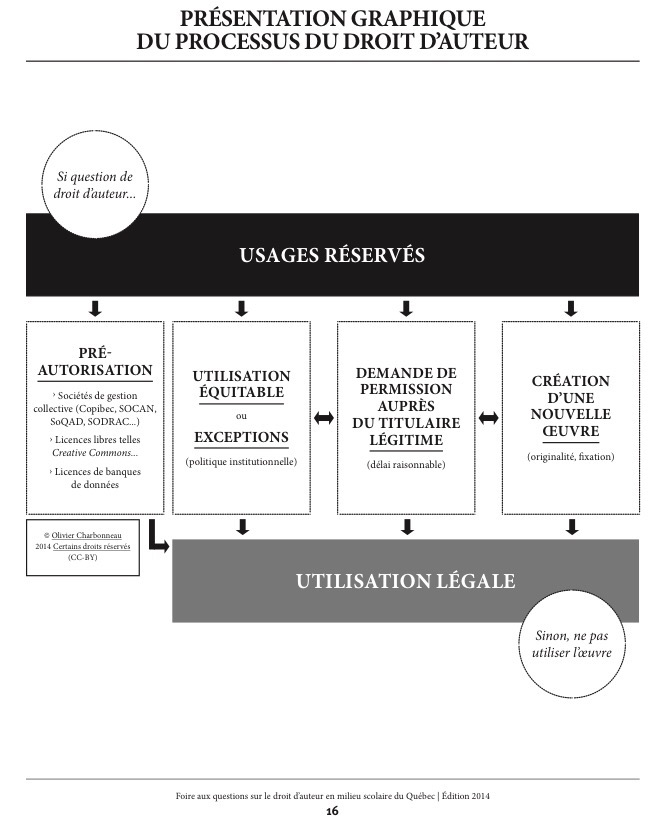
1.2 Digital works are often “compilations” of many other pieces
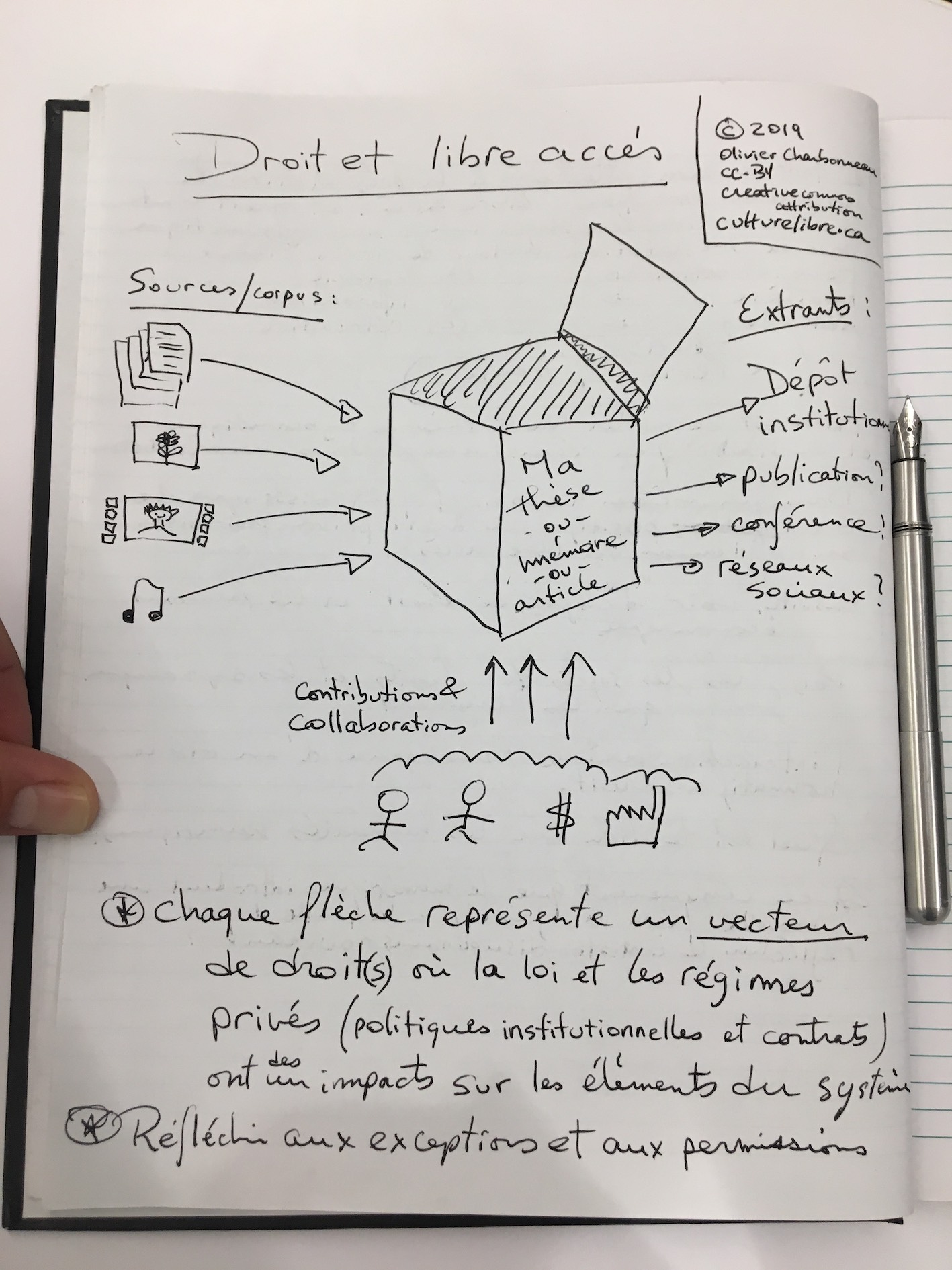
2. Generative Artificial Intelligence
2.1 GenAI at the Library
Concordia University Library offers many opportunities to engage with GenAI. These include:
GenAI Quickstart: Foundations for Faculty
Quick Things for Digital Knowledge
UdeMy subscription
2.2 GenAI at Concordia
Guidelines for Teaching with Generative Artificial Intelligence
3. Conclusion
Your librarian offers a bespoke and dedicated consulting service and is available to meet you, your students or your class upon request.
Academic Integrity Business plans Guidelines - recommendations
How to ethically use articles and reports from databases licensed by a library?
Olivier Charbonneau 2020-06-05
This question is quite astute as it allows me to consider both academic integrity as well as complying with copyright and licensing requirements. I’m periodically asked whether one can send an article or a report from a licensed database by our University Library to someone outside of our University’s library. The gist:
Don’t share, just cite ™
Source: Olivier Charbonneau, Senior Librarian, Concordia University (Montréal)
To expand on this simple guideline I can provide the following insight: our licensing agreements with most of our vendors do not allow members of the University Community to send the verbatim or full reports to parties from the external community. So, please do not forward PDFs from our licensed databases outside of our University. Caveat: anything on the “free web” – such as websites/reports from governments – are free to share in full (as per the Canadian Copyright Act).
I know this is unfortunate but I offer you a silver lining: members of the university community are allowed to read, learn and cite from reports or articles from our licensed databases to draft summaries or briefs. In addition, you can cite from multiple sources to craft a really powerful synthesis of a complex business topic. This resulting paper is your own, as long as you cite short but salient passages from reports or articles our licensed databases and provide the source in a proper bibliography (footnotes and/orendnotes).
This advice stems from a simple ethical rule in research: if you share a single source in full, this is usually called stealing… but if you cite salient but short passages from multiple sources and provide proper references, this is called research. The resulting research paper is yours: the authors of the research paper own the copyright of the resulting paper with citations and can leverage or mobilize it as they wish, like selling it to a client or posting it on the free web.
This is the ethical rule in authorship, in line with various complex copyright or licensing requirements, that exemplifies best practices for the university community. In addition, it also provides for a “value-added” service for business analysis: selecting and arranging salient business insight in a research brief. Believe it or not, this is what you are groomed to do in our business school. Your question exemplifies best practices, that of validating with a colleague how best to proceed given a novel or uncertain context.
In addition to the above insight, please allow me to point out the following resources I’ve created to support Canadian entrepreneurs:
1. I have created a “quick list” of best resources on the free web for entrepreneurship research on this post on my work blog: Researching a business plan using free sources
2. My “expanded” list of resources, with licensed databases from our collection, is on the Library website: Entrepreneurship research guide
In closing, please note that this summer, I shall be overhauling my research guides and corresponding YouTube tutorials, so these sources will shift in the coming months, as fast as this humble librarian (and single dad from an undisclosed location deep in the Montréal Suburbs) can crank out web and video Open Educational Resources. Please consult my work blog, www.outfind.ca, for updates.
Guidelines - recommendations Information literacy Publishing
Articles for business & academic insight
Olivier Charbonneau 2019-01-21
This post contains the lecture notes I will be using in an honors level undergraduate class. Remember, the library offers a Business Research Portal.
1. Is there information on the Internet?
- Lecture; 10 minutes
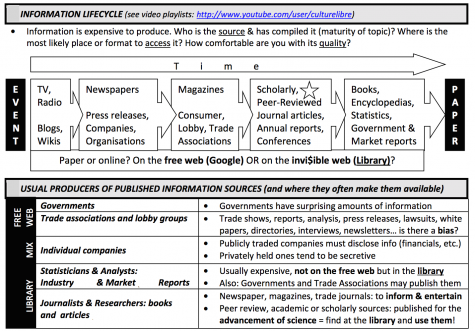
- Synthesis: Information (or more precisely: facts, opinions and data) is contained in documents. Documents may be posted on the Internet or published in electronic or print venues accessible through subscriptions or other forms of payment. A successful search for information implies thinking about (1) the motivations of those creating documents (e.g.: the goal) and their (2) expectations about posting on the internet or publishing in paid-for venues (e.g.: the source).
2. Compare articles
- Activity; 10 minutes; Compare articles from various sources: blog, magazine, trade journal, Wikipedia, subject encyclopedia and scholarly journal
Paper copies: magazines and scholarly journals
Wikipedia (Entry for International business) vs. International Encyclopedia of the Social & Behavioral Sciences (entry for International Business)
Blog (The benefits of online gambling) vs. Research Article (Video Lottery is the Most Harmful Form of Gambling in Canada)
- Focus: distinction between free or invisible (library) web
- Synthesis: all articles are not created for the same audiences. Academic or peer-reviewed articles are the standard way to publish research results. University students are groomed to craft academic articles through writing papers as part of the requirements for their classes
3. Academic articles: structure and editorial process of scholarly communication
- Lecture; 10 minutes
- Synthesis: Structure & Editorial process of scholarly communication.
- Structure of an academic article: research questions; conceptual framework; hypothesis/objectives and method; data & analysis; conclusion (very similar to an academic paper)
- Process: peer review
4. Tools & strategies
- Activity: 20 minutes
- Transforming concepts to keywords for database searching
- Compare Google Scholar and a library article database
- Working from a known item – read the bibliography and explore related articles. Locate the article in a database and obtain keywords
- Data sources on the Internet – be mindful of secrets
5. Outputs
Annotated bibliography: 5 minutes
Academic paper: 5 minutes
Using MS Word(tm) with style
Citing business databases in APA format
Automated citation system: RefWorks or Zotero
6. Questions and discussion
Blended Learning Guidelines - recommendations Information Technology Inspiration Open education
Report on 10 trends that can transform education
Olivier Charbonneau 2014-11-21
A new report from the UK highlights 10 trends or new techniques in education that may have a profound impact on how we teach and learn. Academics from the Institute of Educational Technology and the Faculty of Mathematics, Computing and Technology at The Open University offer us the Innovating Pedagogy report, the third such report released to date.
Here is the outline:
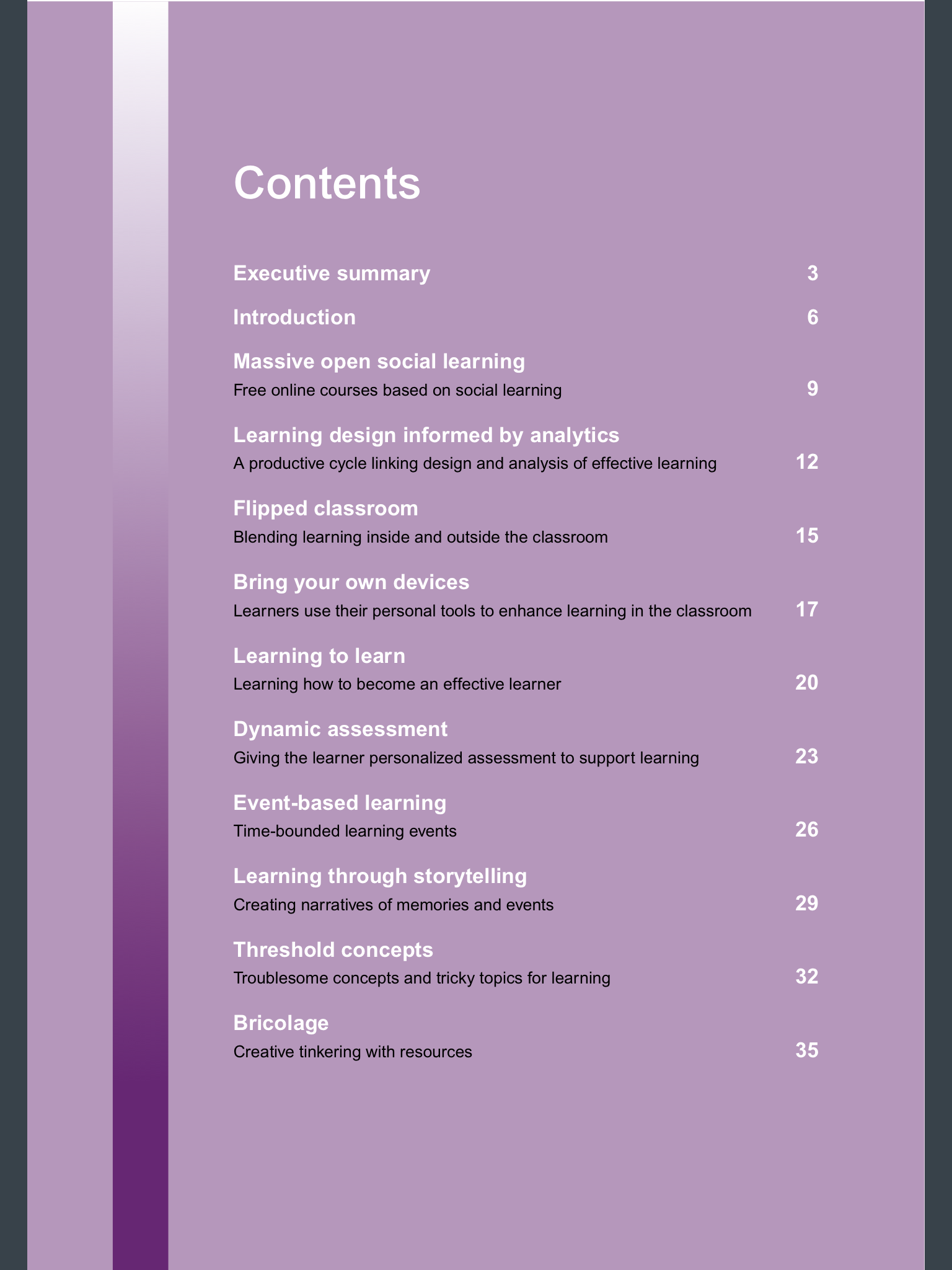
Massive open social learning : Free online courses based on social learning
Learning design informed by analytics: A productive cycle linking design and analysis of effective learning
Flipped classroom: Blending learning inside and outside the classroom
Bring your own devices: Learners use their personal tools to enhance learning in the classroom
Learning to learn: Learning how to become an effective learner
Dynamic assessment: Giving the learner personalized assessment to support learning
Event-based learning: Time-bounded learning events
Learning through storytelling: Creating narratives of memories and events
Threshold concepts: Troublesome concepts and tricky topics for learning
Bricolage: Creative tinkering with resources
Assessment Guidelines - recommendations
Evaluating learning spaces
Olivier Charbonneau 2014-10-08
This new release from the good people at EDUCAUSE seems interesting. It is called the Learning Space Rating System (LSRS) and only covers formal spaces (e.g. classrooms) for now, but will eventually will allow the evaluation of informal learning spaces, such as libraries.
Guidelines - recommendations Librarianship Universities
18 reports for libraries
Olivier Charbonneau 2014-03-27
The Science Blog’s Confessions of a science librarian provides for a list of 18 recent studies and reports targetting discussing contemporary issues in librarianship.
Guidelines - recommendations Information literacy Inspiration
InfoLit Best Practices looking for example cases
Olivier Charbonneau 2014-03-27
According to the Information Literacy Blog, the Association of College and Research Libraries’ Information Literacy Best Practices Committee “is looking for information literacy programs that are exemplary in any of the categories outlined in Characteristics of Programs of Information Literacy that Illustrate Best Practices: A Guideline.”
More information here: http://www.ala.org/acrl/aboutacrl/directoryofleadership/sections/is/iswebsite/committees/bestpractices
Guidelines - recommendations Universities
The more things change…
Olivier Charbonneau 2013-07-02
I liked this interesting take on undergraduate tacit knowledge from this experienced librarian in the Chronicle of Higher Education. Some key take-back points:
Journals and magazines are published as ongoing series. For those of us who remember print, articles are bundled into issues, issues into volumes, and every year more articles are published in these bundles. If every article you ever read was found online, the relationship of articles to a particular journal published in a particular year is not at all obvious.
News is different than opinion. I’m so ancient I grew up with newspapers printed on newsprint, delivered to your doorstep every morning and afternoon. (Hard to believe, but even small cities typically had two major newspapers dividing the day.) One thing that is immediately obvious from the layout of a printed newspaper is that news and opinion are different categories. One could argue that news is strongly influenced by reporters’ opinions or the orientation of the publication, but when it comes to making choices about what information to use and how to use it, the distinction between reporting and opining matters. That distinctiveness is much harder to recognize online.
Read more: Inside Higher Ed

Source: http://www.flickr.com/photos/marinal/8291381232/sizes/o/in/photostream/
It reminded me of and linked to the Beloit College Mindset List, sumarizing what new undergraduates have experienced in their lifetime… an important read for everyone deling with “kids” these days!
Guidelines - recommendations Information literacy
Describing and evaluating an infolit program
Olivier Charbonneau 2013-05-17
Found through an infolit blog, the Research Information Network proposes Criteria for describing and assessing interventions – provisional version last September.
The same group came up with the Finch Report, which looks open access policies in UK universities. I also stumbled on these above guidelines and thought of sharing…