Universities | Page 5
Open education Universities
Open textbook on open education seeks comments
Olivier Charbonneau 2014-06-16
Tony Bates has just posted a call for comments on the first chapter of his open textbook about open education. (talk about putting your money where your mouth is!)
Dr Bates has extensive experience in university teaching and administration – I’m really sorry I missed his talk at Concordia a few months ago (as a dad with young kids, it is hard to make evening events).
I’ll read this chapter soon, but it seems very interesting. I also really like the tool that he is using, namely the PressBooks web-hosted book publishing system.
Assessment Information literacy
Top 20 Library Instruction articles of the year
Olivier Charbonneau 2014-06-06
Interesting, this list of top 20 articles compiled by the Library Instruction Round Table, see page 6 of their latest newsletter. This one seems of particular interest:
Stowe, B. (2013). Designing and implementing an information literacy instruction outcomes assessment program. College & Undergraduate Libraries, 20(3-4),
242–276.
This case study describes and analyzes the efforts of the library faculty at the Brooklyn Campus Library of Long Island University who are involved in developing, testing, and implementing a ground-up information literacy outcomes assessment program for the undergraduate core curriculum. Based on the increasingly prominent role given to information literacy by re-accreditation agencies, the library was prompted to significantly upgrade its assessment practice of collecting anecdotal evidence and administering clickers-based exit surveys. To detail the process of the upgrade, the article discusses such issues as key external and internal institutional forces that influence the development of an outcomes assessment programs. The library faculty members discuss choosing the appropriate assessment instrument (standardized or locally developed), establishing a hierarchy of priorities of assessment areas/goals, determining the actual assessment questions, and building the iterative assessment cycle (pre-assessment and post-assessment). The author includes examples from early versions of the evaluation instruments as well as the revisions of such instruments. The honesty of the library faculty members is disarming—they freely refer to the persistent personnel and managerial issues their library had been facing for some time and are generally very open about the challenges this represented in terms of developing a sustainable assessment program. As a result, this article provides an invaluable resource for other institutions trying to build their outcomes assessment program from scratch.
Blended Learning Information literacy Open education
Technologies for a flipped classroom
Olivier Charbonneau 2014-06-06
This just came out : the latest “Tips and Trends” report from the Instructional Technologies Committee members of the American College and Research Libraries and the American Library Association.
Tips and Trends, written by Instructional Technologies Committee members, introduces and discusses new, emerging, or even familiar technology which can be applied in the library instruction setting. Issues are published 4 times a year.
Technology for Flipping the Classroom
Spring 2014
By Angela Colmenares
Academic Integrity zombies
Kill goblins, avoid plagiarism
Olivier Charbonneau 2014-06-05
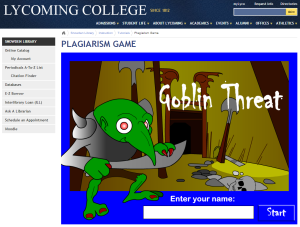 Here is an interesting twist on the old academic integrity issue : a web-game where Goblins are eliminated when you correctly answer questions about plagiarism.
Open education
FutureLearn : MOOCs from the UK
Olivier Charbonneau 2014-06-04
It seems that UK institutions have pulled together to create a common MOOC platform called FutureLearn.
Assessment
Doing away with the essay
Olivier Charbonneau 2014-05-26
Interesting article from the McMaster Daily about an economics prof doing away with the traditional essay. Her solution? Posters. It tests student’s oral skills, allows for one-on-one evaluation and asks students to produce something closer to what employers will value.
Blended Learning Read Me Videos
On compelling videos
Olivier Charbonneau 2014-04-08
Educause has a piece on what makes instructional vidoes compelling. Little surprise, the most viewed have content dealing directly with course activities.
Librarianship Research
What is LIS?
Olivier Charbonneau 2014-04-07
Practionners have a love-hate relationship with Library and information science. Here is a recent article on the topic of whether it is a science or not:
Citation: Fredrick Kiwuwa Lugya, (2014) “What counts as a science and discipline in library and information science?”, Library Review, Vol. 63 Iss: 1/2
(Lugya says yes).
Also of interest, this recent book on theories of information:
Theories of Information, Communication and Knowledge: A Multidisciplinary Approach edited by Fidelia Ibekwe-SanJuan and Thomas M. Dousa (Eds.). London, UK: Springer, 2014. 380 pp. $179.00 (hardcover) (ISBN 978-94-007-6973-1)
DOI: 10.1007/978-94-007-6973-1
(Also reviewed in JASIST)
Open access Open education Universities
University Libraries think about textbooks
Olivier Charbonneau 2014-04-01
A colleague of mine highlighted a few articles which explain how university libraries are engaging faculty and providing assistance to switch to open textbooks. Here are the links:
– For more on open textbooks
– The Alt textbook from Temple’s Teaching and Learning Technology Roundtable
– CBC radio (Calgary) interview about open textbooks
Academic Integrity
Thinking uncreatively
Olivier Charbonneau 2014-03-27
A great way to think outside the box is to give yourself difficult constraints. A colleague of mine pointed out this great lecture featuring Kenneth Goldsmith Poets at the White House, discussing uncreative writing. Arguably, a great example of creatively thinking about the importance of academic integrity or plagiarism:
[youtube http://www.youtube.com/watch?v=nqHaKniXkF8&w=420&h=315]
We were thinking of ways of making academic integrity more meaningful to students. In this other video, my institution takes a radically different approach, scaring students into acting appropriately:
[youtube http://www.youtube.com/watch?v=3BeyUy_QyO8&w=560&h=315]