Librarianship | Page 9
Gamification Information literacy
Quick “gamification” bibliography
Olivier Charbonneau 2013-04-18
Following my post on prof Hirumi, his InterPLAY model and experiential learning,
I sent off to learn more on gamification, eLearning and other related topics. I setup an quick and dirty bibliography on the topic and shared it from my RefWorks site.
In addition to what I have posted in my first post on prof. Hirumi, here are the items in it so far in my gamification bibliography:
Annetta, L. A., & Bronack, S. C. (Eds.). (2011). Serious educational game assessment : Practical methods and models for educational games, simulations and virtual worlds. Rotterdam, Netherlands: Sense Publishers.
Anthropy, A. (2012). Rise of the videogame zinesters : How freaks, normals, amateurs, artists, dreamers, dropouts, queers, housewives, and people like you are taking back an art form (Seven Stories Press 1st ed.). New York: Seven Stories Press.
Haythornthwaite, C. A., & Andrews, R. (Eds.). (2011). E-learning theory and practice. Los Angeles: Sage.
Hirumi, A. (Ed.). (2010). Playing games in school : Video games and simulations for primary and secondary classroom instruction (1st ed.). Eugene, Ore: International Society for Technology in Education.
Juwah, C. (Ed.). (2006). Interactions in online education : Implications for theory and practice. London ; New York: Routledge.
Suits, B. (2005). The grasshopper games, life and utopia. Peterborough, Ont.: Broadview Press.
Werbach, K., & Hunter, D. (Eds.). (2012). For the win : How game thinking can revolutionize your business. Philadelphia: Wharton Digital Press.
I also have another open bibliography on business information literacy.
Concordia University Critical Thinking Gamification Information literacy
Experiential Learning and the InterPLAY Model from prof. Hirumi
Olivier Charbonneau 2013-04-09
 I learned so much from the e.SCAPE conference at Concordia – but professor Hirumi inspired me to look into grounding the curriculum I am developing for business information literacy in proven theories.
Professor wrote a book in 2010 on this model:
Call Number LB 1029 S53P53 2010
Title Playing games in school : video games and simulations for primary and secondary classroom instruction / edited by Atsusi “2c” Hirumi
Edition 1st ed
Publisher Eugene, Ore : International Society for Technology in Education, c2010
He also wrote a book chapter in 2006:
Atsusi Hirumi — Designing interaction as a dialogue game : linking social and conceptual dimensions of the learning process
Call Number LB 1044.87 I548 2006
Title Interactions in online education : implications for theory and practice / edited by Charles Juwah
Publisher London ; New York : Routledge, 2006
Prof. Hirumi’s chapter in this book is available here.
In addition, prof. Hirumi offered some great summaries of contemporary proven learning theories For example, see this 30 page summary I found on a conference website (title: Grounding e-Learning Interactions to facilitate Critical Thinking
& Problem Solving).
During the conference, he presented his InterPLAY model, as seen here from a few of his slides:
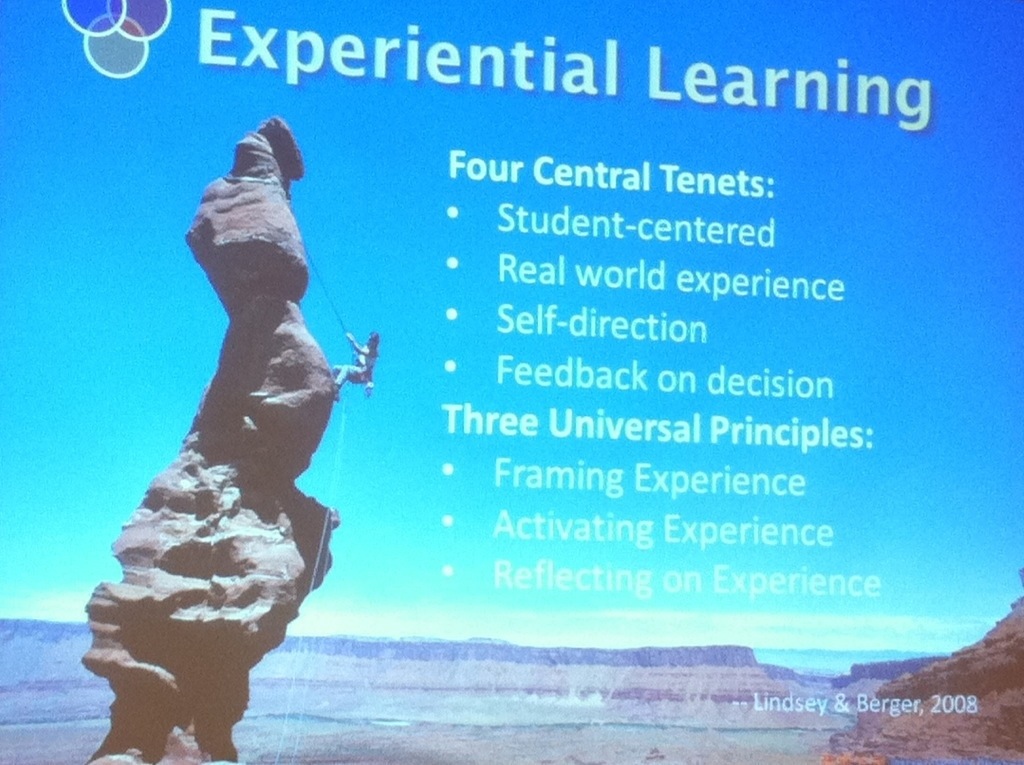
He also presents it as such in the pdf document linked above (title: Grounding e-Learning Interactions to facilitate Critical Thinking
& Problem Solving ). On page 19, he describes it as such:
Interplay Strategy
(Stapleton & Hirumi, 2011; Hirumi, Atkinson, & Stapleton, 2011)
Based on the belief that the learning of facts, concepts and principles occurs best in context of how they will be used, the Interplay strategy evokes emotions and sparks imagination, based on cognitive neuroscience research, to enhance experiential learning theories by addressing three primary conventions of interactive entertainment and their related elements (i.e., Story – characters, events, worlds; Game – rules, tools, goals; Play – stimulus, response, consequences).
1. Expose – Exposure provides the back-story to entice empathy for the character or player, and orients the audience into the same reference point or point of view. Exposure sets up specified learning objectives in a meaningful way to invite the student to contribute, to engage and to achieve the challenges set before them.
2. Inquire – Inquiry validates Exposure. If exposure sets a desire to learn, then inquiry is automatic. Inquire provides a response to student’s curiosity with something to do that showcases different elements that will be used later.
3. Discover –Discovery provides the personal reward, achievement, and the “ah ha” moment. The consequences of discovery, whether negative or positive, provide feedback to inspire further exploration to the next level of achievement.
4. Create – Transforms the experience from being merely reactive to truly interactive. Instead of responding to cues, the learner contributes to the content by applying the elements of the subject matter in novel ways.
5. Experiment – Provides an opportunity to assess learning and provide feedback without losing or winning. The goal is less about the hypothesis being right or wrong, but rather setting up the elements of the subject matter so that new knowledge can be gained. Failure should be fun.
6. Share – The sharing of personal experiences and feelings is facilitated at the end of the lesson or unit, to seal the memory of the learning experience. Sharing compels learners to put lessons learned in their own perspective as well as others.
He presented the context of the InterPLAY model as such:

Bibliography
In addition to the books references above, here are some works prof. Hirumy contributed to:
Crippen, K. J., Archambault, L., & Kern, C. (in press). Using Scaffolded Vee Diagrams to Enact Inquiry-Based Learning. In A. Hirumi (Ed.). Grounded Designs for Online and Hybrid Learning: Practical Guidelines for Educators and Instructional Designers. Eugene, WA: International Society for Technology in Education.
Hirumi, A. (2002). Student-centered, technology-rich, learning environments (SCenTRLE): Operationalizing constructivist approaches to teaching and learning. Journal for Technology and Teacher Education, 10(4), 497-537.
Hirumi, A. (1998, March). The Systematic Design of Student-Centered, Technology-Rich Learning Environments. Invited guest presentation given at the first Education Graduate Students and Academic Staff Regional Meeting, Guadalajara, Mexico.
Hirumi, A. (1996, February). Student-Centered, Technology-Rich Learning environments: A cognitive-constructivist approach. Concurrent session held at the Association for Educational Communication and Technology Conference, Indianapolis, Indiana.
Hirumi, A. & Stapleton, C. (in press). Designing InterPLAY Learning Landscapes to Evoke Emotions, Spark the Imagination, and Foster Creative Problem Solving. In A. Hirumi (Ed.). Grounded Designs for Online and Hybrid Learning: Practical Guidelines for Educators and Instructional Designers. Eugene, WA: International Society for Technology in Education.
Hirumi, A., Atkinson, T., Stapleton, C. (2011). Interplay: Evoking Emotions andSparking Imagination through Story, Play and Game. Concurrent Session presented the annual Association for Educational Communication and Technology conference, Jacksonville, FL. Nov. 8-12.
Stapleton, C. & Hirumi, A. (2011). Interplay instructional strategy: Learning by engaging interactive entertainment conventions. In M. Shaughnessy & S. Fulgham (eds). Pedagogical Models: The Discipline of Online Teaching (pp. 183-211). Hauppauge, NY: Nova Science Publishers, Inc.
Concordia University Information literacy Open access Outfind.ca
e.SCAPE Conference
Olivier Charbonneau 2013-04-08
[youtube http://www.youtube.com/watch?v=8so2aBH7uEI&w=640&h=360]
I gave a talk at the e.Scape conference at Concordia University on the topic of :
The unexpected journey from a 60 minute lecture to a MOOC: a librarian’s mid-way report
Here is the description:
Information Literacy can be understood as the curriculum Librarians must curate without a classroom. Traditionally, this has meant organising library services as well as in-class lectures to advise students on research skills and strategies. But two factors have moved me to explore a new approach. Firstly, the Internet and open education offer incredible opportunities to disseminate knowledge and collaborate with colleagues worldwide. Secondly, as one of the Business Librarians working closely with the John Molson School of Business, my community is broad and their needs are as deep as their passion for their field. In order to meet this challenge, I’ve implemented a series of training videos in order to test a new curriculum deployment strategy.
Learning objectives for the session
Determine the resource implications of designing a MOOC, in terms of effort (time), technology and skill
Evaluate the relevance of the MOOC model for one’s teaching
I briefly discuss MOOCs. More on MOOCs here (this is the video I show in my lecture):
[youtube http://www.youtube.com/watch?v=eW3gMGqcZQc&w=560&h=315]
I position MOOCs as the extreme end of the elearning continuum – both in terms of structure and pace. I may never achieve this end-game in my development of curriculum and learning objects. In fact, I realistically envision that I will develop a series of learning objects that will be embedded in various courses throughout the undergraduate experience at the John Molson School of Business. Taken as a whole, these learning objects may constitute enough content to be called a MOOC or an online class. But for now, I am focussing on developing my curriculum and building meaningful learning objects from that.
Concordia University Information literacy Lectures and conferences Open education
Talking at the e.Scape conference today
Olivier Charbonneau 2013-04-04
I will be giving my talk shortly this morning at the e.Scape conference at Concordia University on the topic of :
The unexpected journey from a 60 minute lecture to a MOOC: a librarian’s mid-way report
I’ll be talking about how my use of technology has changes my professional practice.
I’ll briefly discuss MOOCs also, positioning them as the extreme end of the elearning continuum – both in terms of structure and pace. More on MOOCs here:
[youtube http://www.youtube.com/watch?v=eW3gMGqcZQc&w=560&h=315]
Mostly, I’ll discuss my training videos as well as the development of a business information literacy curriculum as part of my employment, most of which are in various stages as pilot projects or drafts.
Information Technology
Keeping current (With RSS Feeds)
Olivier Charbonneau 2013-03-07
I am giving a “brown bag” session today for the Management Department of the John Molson School of Business about “keeping current”.
Here is the outline of my talk:
– Some warming up exercises (because we have to talk about theories)
– General information about RSS Feeds
– Subscribing to RSS Feeds
– RSS Feeds and Scholarly sources (a journal’s table of contents, filtering and Google Alerts)
– A short video explaining the process of subscribing and reading RSS Feeds
Warming up exercises (theories are useful to organise one’s thoughts)
This initially made me think of Robert Darnton’s account of the Communication Circuit as well as Beaudry’s theories on relationships between authors and other agents in digital publishing (see images below). These models present how authors interact with others in scholarly communication.

Darnton, Robert. “What Is the History of Books?” Daedalus, Vol. 111, No. 3, Representations and Realities (Summer, 1982), pp. 65-83
See also an updated account:
Darnton, Robert “What is the history of books? Revisited” in Modern Intellectual History, 4,3(2007), pp. 495–508 2007, Cambridge University Press
doi:10.1017/S1479244307001370

Beaudry, Guylaine. La communication scientifique et le numérique, Paris : Hermès science publications / Lavoisier, 2011, p. 250
But enough with theories, let’s talk about keeping current with RSS Feeds !
The best tool I can offer to stay current are RSS Feeds (see this great Wikipedia article for a summary). Essentially, RSS is a technology which focuses on the structure of information and eliminates the formatting. Once this happens, you can simply obtain the address of the RSS feed and aggregate content with special software. So, instead of having to browse to multiple websites, you can configure a system to compile content for you.
Here is a video explaining what RSS Feers are:
[youtube http://www.youtube.com/watch?v=t28_PGSYZPU&w=480&h=360]
 To locate RSS Feeds on a website, one needs to locate the address of the various feeds available. These are either located in a special section of the website or readily available from a page you are browsing. Usually, the RSS feed link is next to a bright orange icon with white waves, as is illustrated here.
A good place to start is by looking for RSS feeds from your favorite media outlets, such as the CBC, the BBC, Le Devoir or other sources. Some media sites also have featured blogs which one can subscribe to via RSS feeds.
Subscribing to RSS Feeds
In order to read these RSS feeds, one should use an RSS feed aggregator. This is a special kind of software which simply compiles all new content for you to read at your leasure. Think of it as an email software.
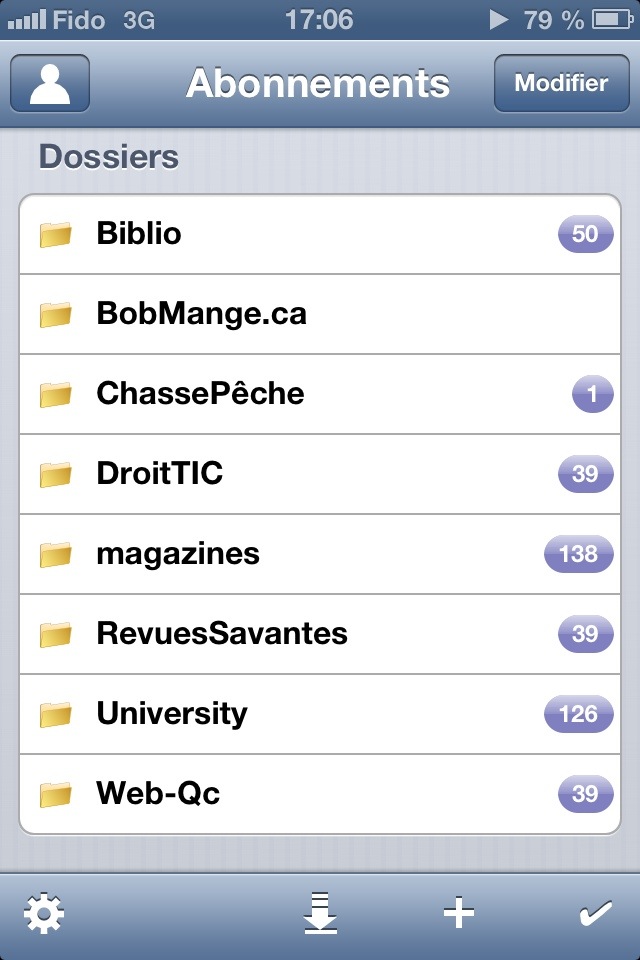
Personally, I use Google Reader to aggregate my RSS feeds. I also use FeeddlerPro to optimize my consumption of RSS feeds on my iPhone. This being said, there are hundreds of possibilities to aggregate and thousands to consume RSS feeds.
This is what happens when I go on vacation for a few days, my RSS content accumulates:
Subscribing to RSS Feeds from scholarly sources
Broadly speaking, there are two options to subscribe to RSS feeds of scholarly sources. You can
1. find the RSS feed address for the table of contents of your favorite journals by looking for the publisher’s website; or
2. set-up RSS feed alerts through article aggregator systems, such as, at Concordia University, ProQuest Business Databases or EBSCO’s Business Source Complete.
For the first option, subscribing to the full table of content means that you would be getting all articles as they are published in each issue. This may be cumbersome or yeild in too many items to read. That is why the second option is interesting: you can simply execute a search and obtain the RSS feed address by looking for that option from the Search History link on the search interface.
This short video demonstrates what I have explained in this post :
[youtube http://www.youtube.com/watch?v=wbDaRD6CjK0&w=640&h=360]
In closing, here is a list of my subscriptions I included on my other blog, Culturelibre.ca.
Open education Presentation Software Videos
GarageBand tutorials
Olivier Charbonneau 2013-02-19
Tip of the had to Kipmusic2345 for her great GarageBand toturials on youtube:
[youtube http://www.youtube.com/watch?v=8MfRHiVHXsU?list=PL919D238C5B8CC8CB&w=560&h=315]
These were really useful for me – I’ve been meaning to start editing sound files for including them in my own digital tutorials.
Information literacy
UNESCO in info lit resources… on 48 languages!
Olivier Charbonneau 2013-02-15
UNESCO announces the
publication titled “Overview of Information Literacy Resource Worldwide” is divided into 42 language lists and includes selected resources – from websites, books, journals and other kinds of publications – that were provided by contributors from different countries and institutions and compiled by Dr Forest Woody Horton Jr.
The document is available in ePub or PDF formats.
Information literacy Videos
My gear to record a session
Olivier Charbonneau 2013-02-15

On the left-hand side (from top to bottom):
– My Blue Yeti ™ microphone with wire
– Sustainable coffee mug
– Manfrotto self-standing monopod
– Black lab notebook
– Kodak Playsport camera with its carry-case (on the lab book)
Middle (from top to bottom):
– MacBook Pro laptop with power cord
– A MacIntosh apple on the laptop for the teacher (Mac-Heads will get the joke)
– A dry-erase board eraser, with a blue marker
– Remote control for data projector
Right:
– A few books used in the demo.
I’m pretty proud to say that I was able to equip myself for less than 2000$ with some decent gear !
Information literacy Universities Videos
MonDiapason.ca – a Quebec library MOOC
Olivier Charbonneau 2013-01-30
I just stumbled on MonDiapason.ca (in French), a site I had seen a demo for 2 years ago at a conference. I’ve heard it may go “live” soon, although there is a lot of content on it already…
Concordia University Information Technology Read Me
So… how do students and profs use technology anyway?
Olivier Charbonneau 2013-01-25
Last May, CRÉPUQ published the results of a study on the attitudes of university students and professors towards technology. The association of Quebec university presidents sponsored the study, which sought to obtain statistically valid information on a broad sample.
University Affairs, a trade publication, interviewed Concordia University’s own Vivek Venkatesh last November and this January about the study, in which he was involved as a researcher. For example, he mentions that:
Our study was not designed to demonstrate the effectiveness of any one (or set of) instructional technique(s) over others. We set out to – and have succeeded in creating – robust, generalizable and predictive models of factors that impact attitudes towards university course effectiveness. Prior research (for example, Wright and Jenkins-Guarnieri, 2012) has analyzed the findings of 11 meta-analyses (193 studies) on student evaluations of teaching, or SETs, with a specific focus on their construct validity, susceptibility to bias, practical use and effective implementation. Their research provides support for the use of SET measures in evaluating instructor skill and teaching effectiveness.
We strongly believe that with a large enough representative sample and a probabilistic sampling strategy, which we have used in our study, gathering students’ perceptions on course effectiveness is a valid measure because it can reflect the reality of what is happening in the classroom – or, dare we say, what should be happening in the classroom. There have been various comments, both as a response to the UA article, as well as in the larger web sphere regarding the generalizability of our results due to a purportedly biased sample and the fact that our research was designed to reach specific conclusions. These assertions are simply untrue and bear very little logic.
You can also listen to a full interview of Vivek Venkatesh on CBC’s Spark.
A further paper will be submitted to the Journal Computers & Education.