Open access Research
CISTI’s DataCite program
I’m attending a WebCast of DataCite, CISTI’s research data management program. I like this slide to answer “why manage data?”:
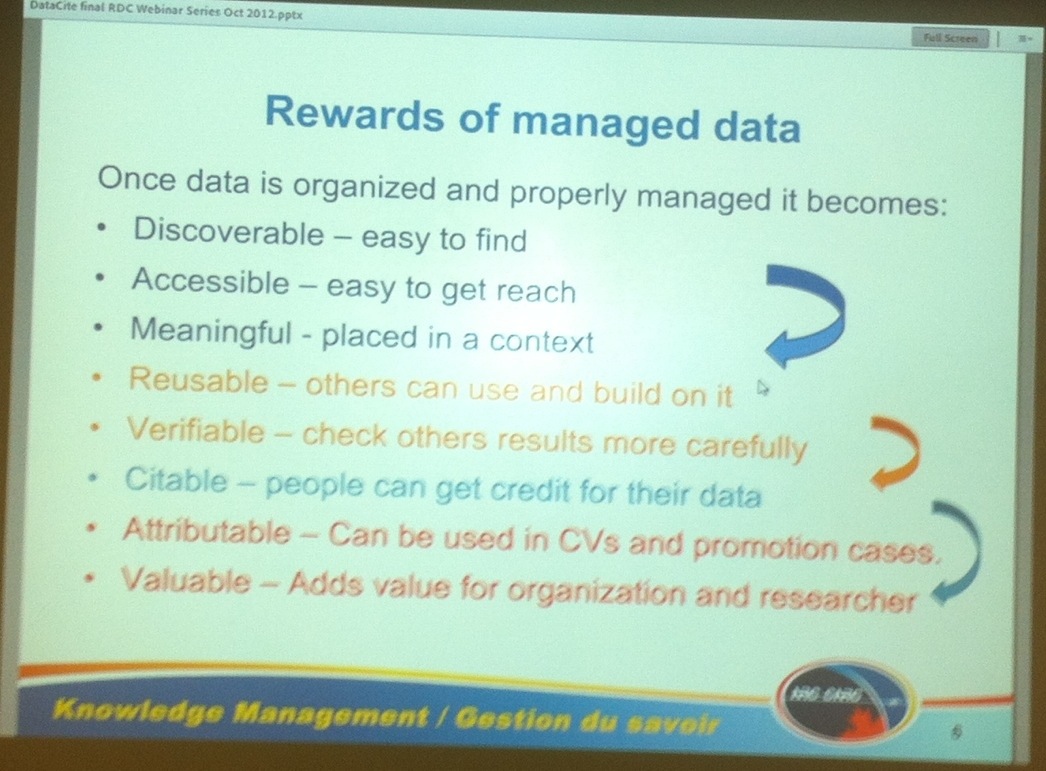
The goal is to assign a DOI to datasets used in research.
I’m attending a WebCast of DataCite, CISTI’s research data management program. I like this slide to answer “why manage data?”:
The goal is to assign a DOI to datasets used in research.
The Association of Research Libraries has issued a brief discussing legal and policy issues of MOOCs. Legal issues focus on copyright. The conclusion summarizes the issues at had for research libraries:
It should be clear from the preceding discussion that libraries have a significant stake in the way their parent and partner institutions approach the MOOC phenomenon. In addition to the strategic concerns already described—keeping fair use on the table, protecting and extending open access policies, ensuring accessibility—research libraries have a more general stake where MOOCs are concerned, which is the continuing relevance of libraries and library collections to university teaching. Will materials in library collections be incorporated, by means of fair use or licensing, into MOOC courses? Will research librarians be trusted experts to whom MOOC instructors turn for help identifying and locating educational resources, whether owned or licensed? Will library values of openness and equal access hold sway, or will the novelty of the MOOC phenomenon lead institutions down a different path? If, as some believe, MOOCs are the future (or at least a significant part or indicator of the future) of university teaching, it is important that research libraries think strategically about how they support this new phenomenon in its formative stages. (p. 15)
Institutions in Canada (and most of Europe) also should consider privacy & anonymity issues of MOOCs. In fact, students are called upon to create accounts and post some information about themselves and their learning process in certain public or quasi-public forums. Although this legal issue can be fixed with clear terms of use, some students may not enjoy the loss of privacy & anonymity that “openness” brings… It seems to me that some thought should be placed on this issue.
A colleague mentioned that librarians at Dalhousie U. have been working towards a Library Council, including interim terms of reference. You can visit all their documents on Dalhousie U’s institutional repository.
From the ProfWeb blog (Profweb : Lancement du concours des prix du ministre : une invitation aux pédagogues de l’enseignement supérieur), we leard that the Guebec government is launching a prize for innovative practices in Higher Ed. Works have to be in French and the deadline is in November for colleges/Cegeps and january for Universities.
In addition to the news of the Gates Foundation giving 9 million dollars for “inovative education practices (see: Wired Campus blog post on June 19th), Google has joined the fray for Massively Open Online Courses (see this other post on Wired Campus, a tech blog of the Chronicle of higher education).
The search Internet giant has launched its “Course Builder” as an open source code project (see: https://code.google.com/p/course-builder/). See Peter Norvig, director of research at Google explain the project:
[youtube http://www.youtube.com/watch?v=GAY5ICoVnA8&w=560&h=315]
Of particular interest is this page about the design process of an online course from Google.
I enjoyed reading this post on a Chronicle of Higher Education blog, called: What Can Angry Birds Teach Us About Universal Design for Instruction? It gives a simple checklist of what makes this mobile game such a success:
Angry Birds involves practice without penalty.
Angry Birds offers the opportunity for constant feedback.
Angry Birds inherently teaches that different tools have different purposes.
Angry Birds has a built in mechanism for knowledge transfer.
Angry Birds rewards perseverance.
Angry Birds gives no time limit.
Also of interest is this post on an event taking place December 10th in Leeds, UK, called Making Games for Libraries, hosted by Andrew Walsh, who has written on active learning. He also is working on an <a href="http://www.indiegogo.com/infolit-gamese" called SEEK!
I just finished reading The Filter Bubble: What the Internet Is Hiding from You
His main argument has to do with how “filters bubbles” emerge from the algorithms that supply the search results or news feeds for social media websites. Since 2009, Google for example supplies search results that are geared specifically to the user making the query. Gone are the days of obtaining “absolute” Google search results based on our terms (where everyone would see the same results). Now, the results we see are “relative” to our likes and features, as seen by Google – our browser, the location of where we are, and about 50 other variables Google uses to identify us as individuals. So, if two people type in the same keywords, they would see different results based on who they are. The Facebook “News Feed” works the same way, and Pariser has reason to believe that this is applied to other websites as well.
Here are some reading notes and quotes I found really interesting:
The filter bubble introduces 3 dynamics (p.9-10): “we are already in it”, “it is invisible” and “you don’t choose to enter the bubble”. In conjunction of how much information we produce, this leads to what Steve Rubel calls the attention crash (p.11).
On “our information diet” : “By definition, a world constructed from the familiar is a world in which there’s nothing to learn.” (p.15) In Robert Putman’s Bowling Alone, we are loosing (p.17) the “bonding capital” (being alike, creating bridges) and “bridging capital” (being able to talk to people not like us).
Facebook’s EdgeRank uses three variables: affinity (how much time we send interacting with someone); the relative weight of the content (relationship status updates vs. pokes); and recency (p.38).
“If trust i news agency is falling, it is rising in the new realm of amateur and algorithmic curation” (p. 66)
The CIA book on information analysis by Heuer (p. 81): The psychology of intelligence analysis also, check out this free version from the CIA website.
“Personalization can get in the way of creativity and innovation in three ways. First, the filter bubble artificially limits the size of our “solution horizon” – the mental space in which we search for solutions to problems. Second, the information environment inside the filter bubble will tend to lack some of the key traits that spur creativity. Creativity is a context dependent trait: We’re more likely to come up with new ideas in some environments than others; the contexts that filtering creates aren’t the ones best suited to creative thinking. Finally, the filter bubble encourages a more passive approach to information, which is a odds with the kind of exploration that leads to discovery.” (p. 94) Mentions The Art of Creation by Arthur Koestler.
Creativity generally has two parts: generative thinking (reshuffling and recombining) ; convergent thinking (survey options) (p. 103)
“If a self-fulfilling prophecy is a false definition of the world that through one’s actions becomes true, we’re now on the verge of self-fulfilling identities” (p. 112). […] “On sirens and children” by Yochai Benkler (p.112) “Autonomy, Benkler points out, is a tricky concept: To be free, you have to to be able not only to do what you want, but to know what’s possible to do.”
“fundamental attribution error. We tend to attribute peoples’ behavior to their inner traits and personality rather than to the situation they’re placed in,” (p. 116)
“In the future, we want to be all well-rounded, well-informed intellectual virtuoso, but right now we want to watch Jersey Shore. Behavioral economists call this present bias – the gap between your preferences for your future self and your preferences in the current moment.” (p. 117)
“Priming effect” (p. 124) – getting people to learn a sequence of words with a theme primes them to think in a way.
“With information as with food, we are what we consume. […] Your identity shapes your media, and your media then shapes what you believe and what you care about. […] You become trapped in a you loop” (p. 125)
“If identity loops aren’t counteracted through randomness and serendipity, you could end up stuck in the foothills of your identity” (p.127) – adapted from Matt Cohler’s “Local-Maximum Problem” – when trying to maximize something – try to go up a mountain, you should always rise – byt you could be stuck on a hill next to the mountain.
Overfitting: being stuck in a class that does not fit us – “a regression to the social norm” (p. 129) “But the overfitting problem gets to one of the central, irreducible problems of the filter bubble: Stereotyping and overfitting are synonyms” (p.131) The problem of finding a pattern in the data that is there and the problem of finding a pattern that is really not there.
David Hume and Karl Popper in the induction problem (p.133) All swans I see are white, therefore all swans are white.
“Fyodor Dostoyevsky, whose Notes from the Underground was a passionate critique of the utopian scientific rationalism of the day.” (p. 135) “But algorithmic induction can lead to a kind of information determinism” (p.135)
“China’s objective isn’t so much to blot out unsavory information as to alter the physics around it – to create friction for problematic information and to route public attention to progovernment forums. While it can’t block all of the people from all of the news all of the time, it doesn’t need to. «What the government cares about,» Atlantic journalist James Fellows writes, «is making the quest for information just enough of a nuisance that people generally won’t bother» The strategy, says Xiao Qiang of the University of California at Berkeley, is «about social control, human survailance, peer pressure, and self-censorship.»” (p.139)
“James Mulvenon, the head of the Center for Intelligence Research and Analysis, puts it this way: ” There’s a randomness to their enforcement, and that creates a sense that they’re looking at everything.” (p. 140)
On governments manipulate the truth “Rather than simply banning certain words or opinions outright, it’ll increasingly revolve around second-order censorship – the manipulation of curation, context, and the flow of information and attention.” (p.141)
Sir Francis Bacon = “Knowledge is power” “If knowledge is power, then asymmetries in knowledge are asymmetries in power” (p. 147)
David Bohm On Dialogue “To communicate, Bohm wrote, literally means to make something common” (p.162-3) Jurgen Habermas “the dean of media theory for much of the twentieth century, had similar views”
«Kranzberg’s first law: “Technology is neither good or bad, nor is it neutral”» (p.188)
“In this book, I’ve argued that the rise of pervasive, embedded filtering is changing the way we experience the Internet and ultimately the world. […] Technology designed to give us more control over our lives is actually taking control away.” (p. 218-9)
“Appointing an independent ombudsman and giving the world more insight into how the powerful filtering algorithms work would be an important first step.” (p. 231)
An interesting read, this post about the Open Repository conference in Edinburg. there is much talk of including raw data in IRs:
Just about everyone was discussing RDM, or Research Data Management. It has become clear that institutional repositories must not only manage scholarly publications, but the data that was created through observation and experimentation or collected and published, in order to support the “re-” activities: review, reuse, replicability and reproducibility. RDM platforms are needed to help researches capture and share and publish their datasets. The public-facing discovery infrastructure is but a small part of this effort: the greater need and effort is in capturing data from the original instruments and formats and the transfer and documentation of datasets in a reliable, documented way to support a forensic level of authenticity for future researchers. The Digital Curation Centre has a great blog post reviewing some of the sessions on this topic.
“Pssst… you may want to check out Google’s Free classes called Power Searcher…” said my colleague’s email. Although I know, use and teach many of Google’s advanced features, I could not resist to test-drive their online learning platform and initiative.
In a quick take, the site is streamlined and the tone is consensual, unscripted yet structured and slightly too slow. I also love the design of the class site, elegant and uncluttered, in true Google fashion :

Classes in a course

Lessons in a class
I also like the pace, or how all learning objects are integrated in the flow of the initiative. Each lesson, a 3 to 8 minute video, is followed by activities, usually multiple-choice of short answer questions. Learners are also called upon to open new tabs and perform steps outside of the environment.
Also, videos start with a slide, showed for 3 or 5 seconds, that cover the learning objectives/outcomes of the lesson. Daniel Russell, Senior Research Scientist at Google, provides for en engaging series of videos. Usually, the focus is on slides from a Presentation with his “talking head” in a smaller window – this is the same setup I use for my own training videos.
Now, the only criticism I can provide is the subtext of the presentation. Now, this is a corporate learning initiative, so I was expecting to get fed a lot of Google products (this actually – surprisingly – is quite pleasantly accomplished). But what slowly got on my nerves is that Daniel Russell assumes gingerly that everything you would ever wish to find is on the free web, indexed by Google.
To be fair, in one activity, he did point out that you may have to use another search system (in that case, a statistics database from a governmental agency) to locate your answer. Now, this issue is probably too much on my mind because I try to get University students to look beyond the free web for their papers…
Honestly, this criticism is very personal and I want to congratulate and thank Daniel Russell and the folks at Google for this engaging, interesting and relevant tour of their “Data garden” – Merci !
this article from the Library Journal provides interesting insight into creating a copyright team.